


Issue No. 1 · The First Week · The diabetic place to be

You just got the news.

You're not alone in this.

0

people already use GoCoCo to find food they can eat.
The GoCoCo Table is where they sit down together.

Free. One letter a week when we open. No lectures, no shame.

✓
Your seat is reserved. We'll send you Issue No. 1 the day we open — watch your inbox.
Scroll
1,200,000+
App users already
scanning shelves
GoCoCo · Verified
96M
Americans living with
T2D or prediabetes
CDC · 2024
≤7.0%
A1c target for most
T2D adults (ADA 2024)
American Diabetes Assoc.
3 RDs
Reviewing every claim
before it publishes
GoCoCo Advisory Board

Point. Scan. Know exactly what you're eating.

GoCoCo scores every product — NOVA classification, carb profile, processing level. Some products surprise you. Good ones and bad ones. Pick one below, hit scan.

Scanning
Choose a product →
📱
Select a product and hit Scan
—
/10
—
NOVA —
GoCoCo Score
—
—
—
—
As seen on
CBS Bloomberg FOX MasterChef El País
01 · The Columns Three voices, one standard

Our columnists write what the pamphlet didn't say

Every piece is written by one of three editors. One rule: every claim carries its source.

The Medical Eye

The Science of the Plate

by Nora, RD

Why the same thirty grams of carbohydrate can behave like two different foods.

A slice of white bread and a bowl of lentils can carry similar carbohydrate counts and still write completely different stories on a glucose meter. The difference is mostly fiber — it slows digestion, flattens the glucose rise (ADA). The lentils arrive gradually. The white bread arrives all at once.

Refined starches behave much like sugar once digestion begins. What protects you is structure: intact grains, skins, seeds, beans. A practical start: half the plate non-starchy vegetables, a quarter protein, a quarter carbohydrate — the fibrous kind (ADA).

Responses vary. Your meter will teach you your own patterns better than any column can.

Cited · ADA Standards of Care · reviewed before publication

The One Living It

Ninety Days

by Mike

Week three: the breakfast that finally stopped fighting me.

The doctor's office gave me a pamphlet and a follow-up date. The parking lot gave me twenty minutes of sitting with my hands on the wheel, not driving. Nobody tells you that part. I didn't start with a plan. I started with breakfast, because breakfast was the meal that kept losing.

I swapped the cereal for plain Greek yogurt with walnuts and a handful of berries. Not because a guru said so — because it was the simplest trade I could make without mourning anything. Week three, my mid-morning number came back and it was just… fine. I stood in the kitchen and read it twice.

The fear shrinks a little every time a number turns out to be information instead of a verdict. Start with one meal. Let it be the easy one.

A diary, not advice · his plan is his care team's
The Related One

The Family Table

by Carmen

One pot, two diets, and the rice question my family had to answer.

When my husband was diagnosed, the first thing I grieved was not sugar. It was rice. In our house rice is not a side dish; it is the center of gravity, the thing my mother taught me and her mother taught her.

We did not banish rice. We changed its proportions — a smaller mound, more vegetables folded through it, beans doing more of the work. One pot. One table. Adjusted, not divided.

"Should you be eating that?" is a sentence that has never once helped anyone. I cook with love. I no longer police with it. Both, it turns out, are acts of care.

The family angle · support without policing
Deep Dive · The Glucose Diaries by Nora, RD

What your blood sugar is actually doing

Two things newly diagnosed people consistently misunderstand. Both will reorganize how you read your meter.

Common Surprise No. 1

Why you wake up with high glucose — even without eating

Between 3am and 8am, the body releases cortisol, glucagon, and growth hormone as biological preparation for the day. Without insulin resistance, the pancreas compensates instantly. With T2D, that response is slower or incomplete.

The result: morning readings 20–40 mg/dL higher than when you went to sleep, regardless of what you had for dinner. This is the dawn phenomenon — a hormone problem, not a food problem. Knowing that is the first useful thing.

What helps: light protein at bedtime, morning exercise, medication timing. What doesn't: eating less for dinner.

ADA Standards 2024 · cortisol-glucose endocrinology research
Common Surprise No. 2

Pasta spikes less than white rice — and why that changes things

Pasta, cooked al dente, has a lower glycemic index than white rice for most people. This surprises nearly everyone who switches to rice as their "safe carb." Pasta has a protein matrix that encases the starch and slows digestion. White rice is almost pure accessible starch.

The variables that matter even more: portion size, what you eat alongside it, and texture. Overcooked pasta loses its al dente structure and behaves more like white rice.

Your meter + the GoCoCo meal photo feature is the only way to know how your body specifically responds.

ADA glycemic index guidance · pasta matrix research · PREDIMED study
The standard behind the standard

GoCoCo was built with registered dietitians. This magazine holds itself to their bar.

Every health claim is cited. Clinical answers come from the clinical desk. Nothing publishes that your care team would wince at.

Juan Revenga RD
Juan Revenga
RD
Prof. Univ. San Jorge
Mariona Balfegó RD
Mariona Balfegó
RD · PhD
T2D nutrition research
Julie Ruelle RD
Julie Ruelle
RD
20+ yrs clinical practice
02 · Letters Real App Store reviews

The community already exists. Hear it.

Real App Store reviews of GoCoCo, reprinted exactly. The Table didn't have to invent its community — it has been eating better for years.

Love this helps me control my diabetes. Things I thought were healthy were actually not
mrsjrobins · App Store · ★★★★★ · Jan 18, 2026
I use it while grocery shopping and at home to scan products and ensure they're safe for me to eat while keeping my blood sugar levels in check.
Reason4rob · App Store · ★★★★★ · Apr 10, 2025
This app consistently helps me understand food content so that I can control my diabetes. A huge help!
Thomas S Redmond · App Store · ★★★★★ · May 25, 2026
This app is great in helping me in deciding the foods l can eat and those I should avoid
Oaklandsraider · App Store · ★★★★★ · Jun 24, 2026
Community · A1c Corner The number that matters most

What A1c means — and the people who moved theirs

A1c measures your average blood glucose over 2–3 months. Every 1% reduction lowers long-term complication risk by ~25–37%.

< 5.7%Normal range
5.7–6.4%Prediabetes
≥ 6.5%T2D diagnosis threshold
≤ 7.0%Target for most T2D adults (ADA 2024)
Community trajectories — A1c over time (months)
7% target 11 10 9 8 7 6.5 0 2 4 6 8 months → Rob 9.1→7.2 Priya 6.8→6.1 Marcus 10.4→8.3 Dana 6.3→5.8
03 · The Shelf Editor's picks, scored 1–10

This month's market page

Real shelves, real stores — scored the way the GoCoCo scanner scores them.

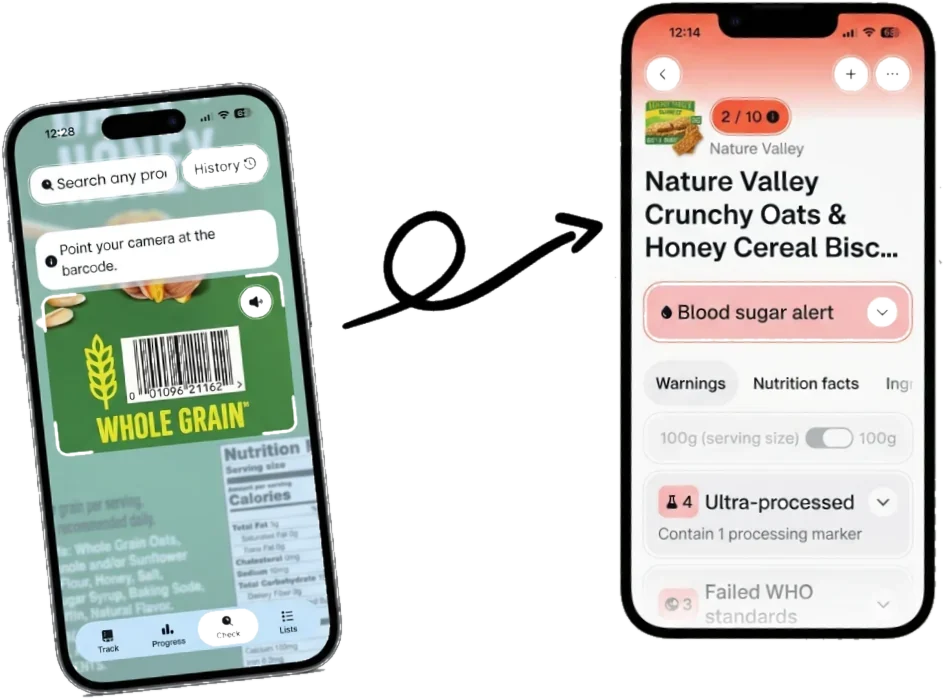
GoCoCo app scoring a product at the shelf
At the shelf — a barcode, scanned; a score, returned.
Walmart
Plain Greek yogurt
instead of fruit-on-the-bottom cups
"Protein first; add your own berries and the sugar math changes entirely." — Nora
9/10
Kroger
100% whole-grain bread, 3g+ fiber
instead of "wheat" bread with 1g
"Fiber is the number to read. 'Wheat' on the front is decoration." — Nora
8/10
Costco
Frozen riced cauliflower
folded into a full pot of white rice
"Half the carbs without touching the ritual. My pot, my rules." — Carmen
9/10
Target
Unsalted mixed nuts
instead of the office vending machine
"The three o'clock snack that doesn't ask my meter for forgiveness." — Mike
8/10
Aldi
Nut butter, no added sugar
instead of the one with a dessert label
"Two ingredients. A good label reads like a haiku." — Nora
8/10
Walmart
Unsweetened sparkling water
instead of soda, diet or otherwise
"The soda shape and the soda sound, without the soda math." — Mike
9/10
Scanner Report · The UPF Reveal NOVA Group 4 explained

Four products the "healthy" aisle didn't fully explain

Ultra-processed (NOVA Group 4) foods are industrial formulations. The classification depends on what was done to the food — not just the sugar or fat count.

NOVA Group 4
Flavored instant oatmeal
"Heart healthy. Whole grain. Low fat."
Contains maltodextrin, artificial flavors, guar gum. Faster starch absorption than plain oats despite similar carb count.
→ Plain rolled oats + cinnamon: NOVA 1
NOVA Group 4
Low-fat fruit yogurt
"Probiotic. 0% fat. Bone health."
Modified starch, gelatin, industrial natural flavors, added sugars. Probiotic cultures frequently don't survive shelf life at clinical doses.
→ Plain Greek yogurt + fresh berries: NOVA 1
NOVA Group 4
Multigrain crackers
"Multigrain. Excellent source of whole grain."
Enriched flour listed first. "Multigrain" means multiple grains — not whole grains. Contains added sugar and palm oil.
→ Wasa Light Rye crispbread: NOVA 1, 4g fiber
NOVA Group 4
Protein granola bar
"Low glycemic. Gluten-free. Non-GMO."
Glucose syrup, soy protein isolate, palm kernel oil. "Low glycemic" is an unregulated marketing claim — scan, then test.
→ Unsalted nuts + one date: real food
04 · The Table This week's menu

Three dinners worth setting the table for

Composed for flavor first, carbohydrate awareness second.

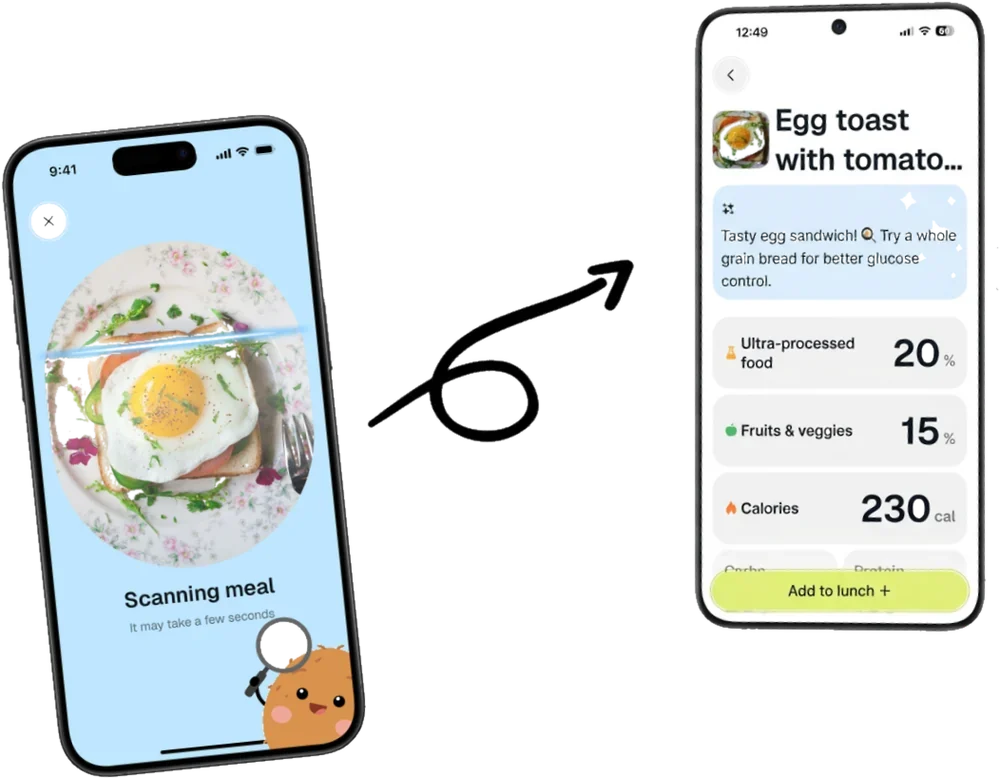
A meal with each food named by GoCoCo
One photograph, every food named. The app reads the meal; the Table sets it.
Tuesday
Sheet-pan salmon with charred broccoli & lemon

One pan, twenty minutes. Olive oil, garlic, a proper amount of lemon.

14g carbsRD reviewed
Thursday
White-bean & kale soup with parmesan broth

Beans bring the fiber that slows the carbohydrate — comfort food and good counsel at once.

28g carbsRD reviewed
Saturday
Chicken fajita bowl on cilantro-lime cauliflower rice

Carmen's one-pot philosophy: the whole family eats this one, no separate plates.

22g carbsRD reviewed
Cultural Table · Issue No. 1 La Mesa Española — Juan Revenga, RD

Three Spanish staples: what the diagnosis changes, and what it doesn't

Cultural food is not a problem to solve — it is a starting point for adaptation.

Tortilla española

~18–22g carbs per slice

Egg, potato, olive oil, onion. The potatoes are the carb concern. Olive oil and egg protein significantly slow glucose absorption compared to plain potatoes. A half-portion alongside a salad is a complete, manageable meal.

The GoCoCo scan rates tortilla favorably compared to other potato dishes — the protein and fat matrix changes the equation.

Juan's tip: More egg, less potato per slice — without changing what it fundamentally is.

Pan con tomate

~20–28g carbs (bread-dependent)

Bread rubbed with ripe tomato and drizzled with olive oil. The challenge is the bread. Sourdough's fermentation gives it a lower glycemic index than commercial white bread.

A small portion as part of a full meal, not as a standalone snack, keeps the glucose response moderate. The tomato and olive oil cause no glucose concern at all.

Choose sourdough or rye. Measure the bread — the tomato and olive oil are unrestricted.

Gazpacho

~8–10g carbs per 250ml

The good news dish. Cold tomato soup: tomatoes, peppers, cucumber, olive oil, vinegar, garlic. Near-zero glycemic impact. Substantial fiber, lycopene, anti-inflammatory polyphenols.

Research shows lycopene from tomatoes may improve insulin sensitivity. Daily consumption in summer raises no concern.

Juan's note: commercial versions often add sugar. Homemade is categorically different — make it yourself.
05 · The Ask Answered by Nora, RD

The questions everyone asks in week one

Sent in by readers, answered with sources. Medical questions are always answered this way — by the clinical desk, in writing, with citations. Never by the crowd.

Q.01Is fruit off-limits now?

No. Whole fruit arrives with fiber, water, and structure that slow absorption. Fruit juice arrives without them — it behaves more like soda than like an orange. Berries pair modest carbohydrate with high fiber (ADA)¹.

Portion still matters — a banana isn't a problem, five bananas are a pattern. Your meter, checked after a serving of fruit you love, will tell you more than any list.

— Nora, RD
Q.02What does "ultra-processed" actually mean?

Industrial formulations assembled from refined ingredients and additives you wouldn't find in a home kitchen, engineered for shelf life and intense palatability. Research links them to higher T2D risk and poorer metabolic outcomes (CDC)².

The practical cue is the ingredient list — the longer and harder to pronounce, the more processed. This is exactly what the GoCoCo scanner estimates on the shelf.

— Nora, RD
Q.03Do I need to count every carb?

For many people with T2D not on insulin, strict gram-counting isn't required. What matters more is awareness: knowing which foods carry carbohydrate, keeping portions steady, spacing them through the day. The plate method exists so that eating well doesn't demand arithmetic (ADA)³.

— Nora, RD
Q.04Why does stress raise my glucose even when I haven't eaten?

Cortisol and adrenaline signal the liver to release stored glucose as a "fight or flight" preparation. Without insulin resistance, the pancreas compensates quickly. With T2D, that response is delayed — blood glucose can rise meaningfully from stress alone. Sleep deprivation works the same way. Your meter is reading more than just your meals.

— Nora, RD
Q.05What is a CGM and should I get one?

A continuous glucose monitor (CGM) wears on the arm or abdomen, reads glucose every few minutes, and sends the full curve to your phone — how glucose rises after a meal, how it falls, what repeats. Even a 2-week trial gives more actionable personal data than months of random fingersticks. Ask your care team specifically about a trial. The GoCoCo glucose tracking works alongside CGM data to connect what you ate to what happened.

— Nora, RD
1, 3 — ADA Standards of Care & nutrition consensus. 2 — CDC; observational research on ultra-processed dietary patterns.
Educational content, not medical advice. Diagnosis and targets belong to your care team.
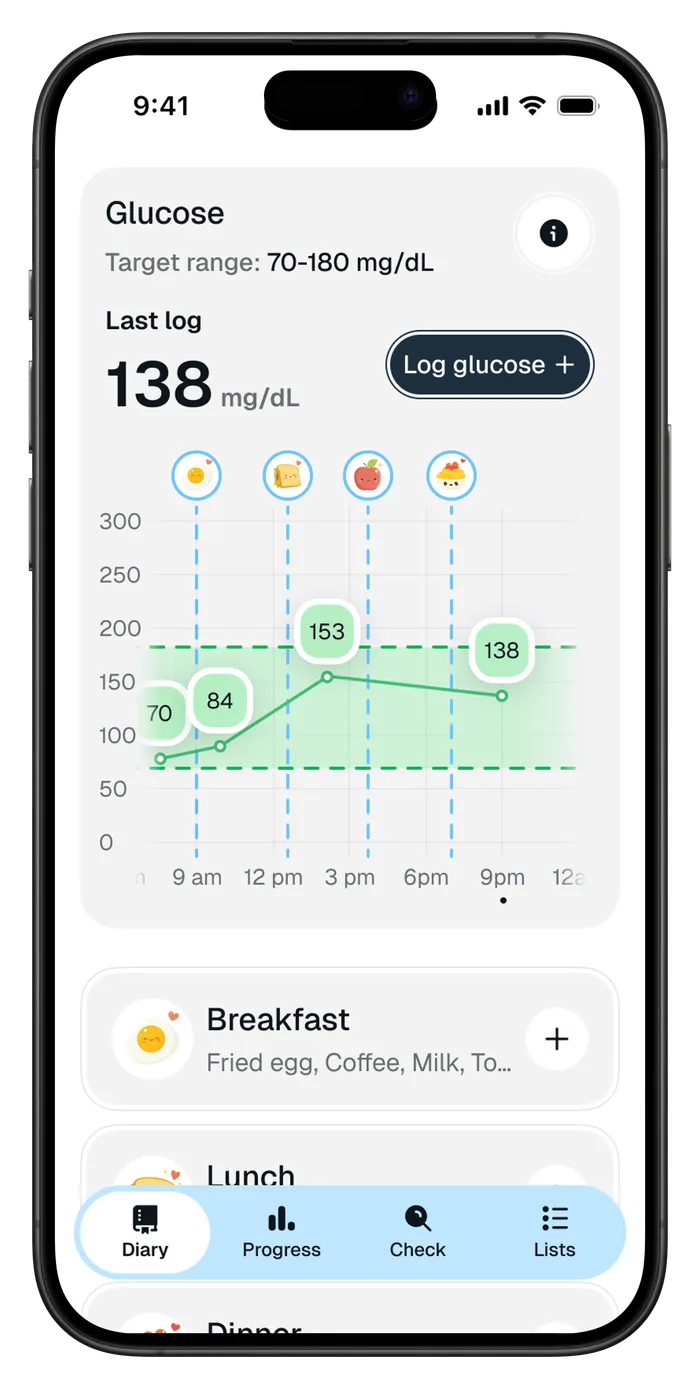
GoCoCo glucose screen — readings over a day
Numbers as information, not verdicts — a day of readings against a target range.
Meal analysis in GoCoCo
One photograph, one read: ultra-processed content, vegetables, calories, carbs.

The app reads the plate. The Table is where we talk about what's on it.

Start Here · Your First 30 Days A permanent guide

The first month, week by week.

Nobody needs to fix everything in week one. The goal is to understand, then adjust — in that order.

01
Week One

Observe. Don't fix yet.

Your only job is a baseline. Eat how you've been eating. If you have a meter, check fasting in the morning and 2 hours after your largest meal. This data is worth more than any meal plan given before anyone knows how you respond.

02
Week Two

Find your personal triggers.

Glucose response is individual. The food that spikes your neighbor may barely affect you. Use the GoCoCo scanner before you buy. Take meal photos in the app. After 7 days of data, one or two personal patterns will emerge.

03
Week Three

Build one repeatable meal.

Pick one meal — usually breakfast — and find a version you genuinely like that keeps your 2-hour glucose under 140 mg/dL. That becomes your anchor. One sustainable meal beats a perfect diet held for three days, every time.

04
Week Four

Prepare for your follow-up.

Write questions before the appointment. The one to ask: "What is my A1c target, and what's the plan if I don't reach it in 3 months?" Come with data, come with questions — that conversation is where general science becomes your personal plan.

06 · Together Your seat is waiting

Your table is already set. More than 1,200,000 people already use GoCoCo — this is where we sit down. No lectures, no before-and-after photos, no miracle anything.

This community isn't starting from zero — it's been eating better with GoCoCo for years, one scanned shelf and one photographed plate at a time. The Table gives it a place to talk: shelf finds, honest first-ninety-days notes, a challenge each week, and a clinical desk that answers the scary questions in writing, with sources. Medical talk goes to the professionals. That rule keeps this place safe — and kind.

Free. One letter a week when we open. No lectures, no shame.

✓
Seat reserved. Issue No. 1 arrives the day we open.

They found the table. You will too.

First names only. One thing that worked. A living wall that grows every week.

Rob · Texas

"Switched yogurt. Added a walk after dinner. A1c dropped from 9.1 to 7.2 in six months."

Priya · California

"Replaced juice with whole fruit. That's it. A1c went from 6.8 to 6.1."

Marcus · New York

"The scanner changed how I see every label. I thought I was buying healthy things."

Dana · prediabetes

"Fixed breakfast, changed nothing else. A1c 6.3 to 5.8 in eight months."

Carmen · Florida

"One pot, one table. I fold cauliflower rice into the pot. Nobody notices."

James · Ohio

"Learned the dawn phenomenon. Stopped blaming dinner for my morning numbers."

Soo · Washington

"Pasta spikes me less than rice. I would never have known without testing."

Lena · Texas

"The first 30 days guide was all I needed. One meal at a time was enough."

Thomas · Georgia

"Nuts and sparkling water replaced the 3pm snack. My meter stopped complaining."

Adela · Arizona

"I make gazpacho every week. High summer, no glucose concern at all."

Mike · Illinois

"Week three: my morning number came back fine. I stood in the kitchen and read it twice."

Okafor · Maryland

"Scanned four 'healthy' products. Three were NOVA Group 4. The scanner doesn't lie."

Community Partners
Diabetes Sisters Food Fight USA American Diabetes Association CDC Diabetes Prevention Program